
OT security and industrial connectivity
Test Equipment Modernization
Bring existing test and measurement equipment into the digital age.
Many test and measurement machines are mechanically sound and still perform their core function reliably, but their controls, interfaces, data handling, and connectivity no longer meet today's requirements.
We modernize existing test equipment with new controls, interfaces, data acquisition, and connectivity so it can integrate with your current production, quality, and IT systems.
Our focus is on small and medium sized test and measurement machines used for applications such as quality control, endurance testing, functional testing, process validation, and laboratory measurements.
Extend machine life. Improve data access. Connect existing equipment to modern systems.
Retrofit or replace
Why retrofit instead of replace?
Replacing a proven test system is often expensive, disruptive, and unnecessary.
In many cases, the mechanical system, fixtures, sensors, actuators, and test process are still perfectly usable. The limitation is usually in outdated electronics, obsolete control hardware, unsupported software, or missing connectivity.
A targeted retrofit allows you to preserve the parts of the machine that still work while modernizing the areas that limit productivity, maintainability, and data availability. Typical reasons for a retrofit include:
Obsolete PLCs, HMIs, PCs, or controllers
Unsupported operating systems
Difficult or unreliable data export
Manual recording of measurement results
No connection to MES, ERP, databases, or cloud systems
Limited traceability
Proprietary interfaces that are difficult to maintain
Missing remote diagnostics
Increasing downtime due to aging electronics
A need to standardize several older test systems
Smarter investment
Lower investment, faster payback
A retrofit preserves the capital already tied up in a working machine and renews only the parts that limit performance. The budget goes into capability rather than into replacing what is still sound.
Scope
Typical machines we modernize
Our retrofit services are particularly suited to small and medium sized test and measurement systems. Examples include:
Quality control stations
Sensor calibration stations
Laboratory measurement equipment
Endurance and lifetime test rigs
Custom production test machines
Industrial measurement devices
Examples
Typical retrofit scenarios
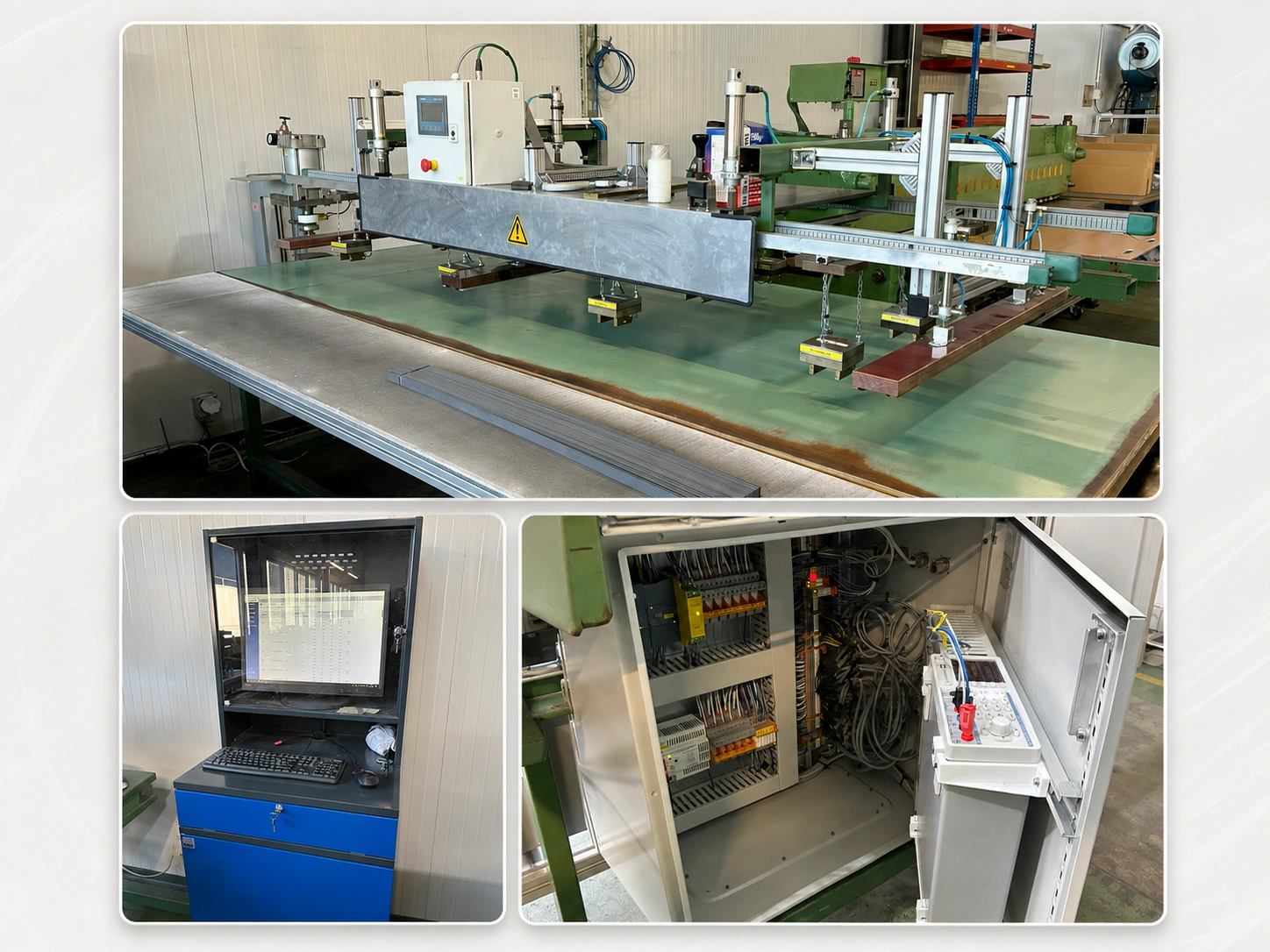
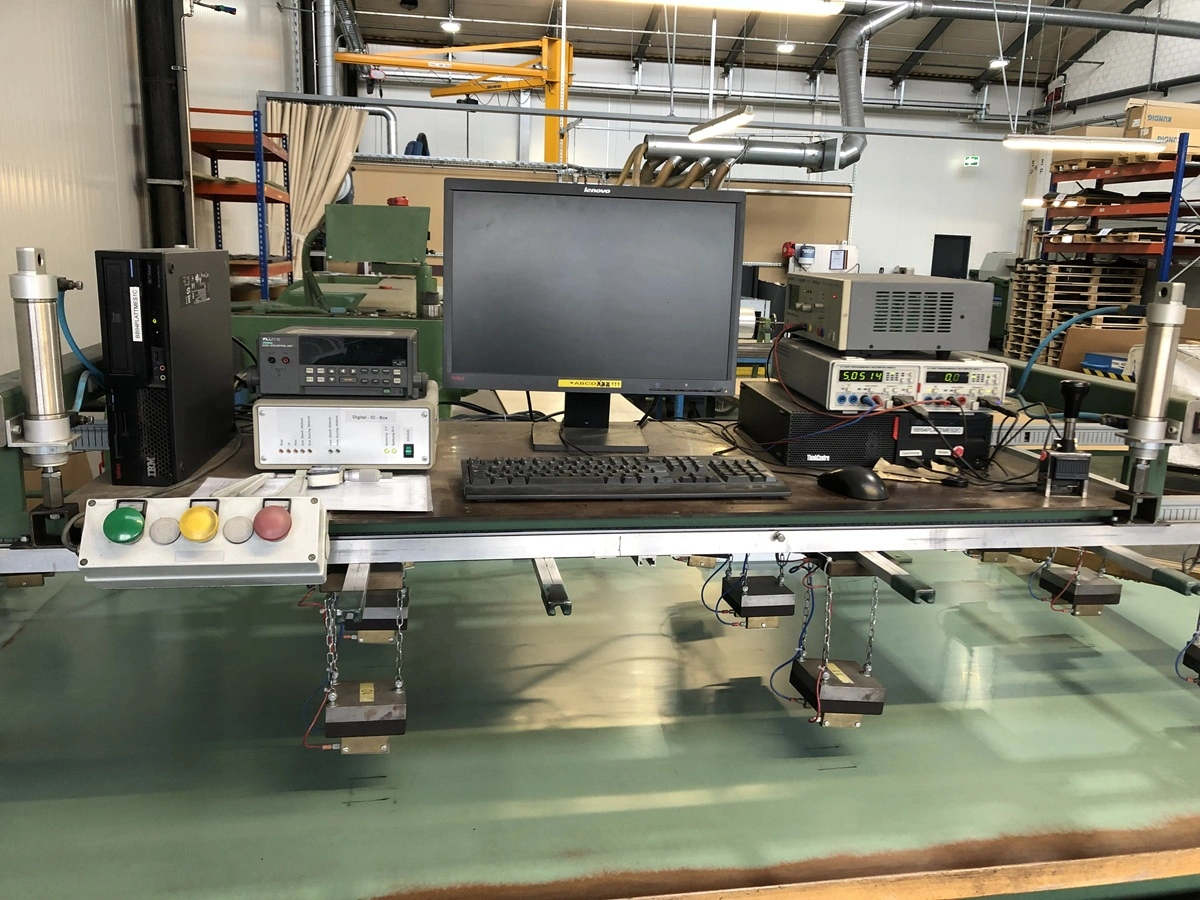
Every test machine is different. Some systems only need a communication gateway and automatic data export. Others require a complete control and software modernization.
We do not treat every retrofit as a full rebuild. The goal is to identify the smallest practical intervention that delivers the required improvement while preserving as much of the existing machine as possible.
Drag the handle to compare before and after
We do not treat every retrofit as a full rebuild. The goal is to identify the smallest practical intervention that delivers the required improvement while preserving as much of the existing machine as possible.
From outdated software to a future-ready platform
The existing software can no longer be maintained, depends on a legacy Windows environment, and cannot be updated to support new requirements.
The retrofit introduces a scalable, maintainable platform that supports future functionality, simplifies updates, and reduces dependence on a specific PC or operating system.
From costly repairs to fast and affordable maintenance
Failures result in time consuming repairs, hard-to-find spare parts, and may result in permanent machine downtime.
Supported hardware and a maintainable system architecture make repairs faster, easier, and significantly more cost-effective.
From isolated machine to secure production connectivity
The machine operates as a standalone system with no practical way to connect it to the production network.
The retrofit enables secure machine connectivity aligned with IEC 62443 principles.
From manual data handling to automatic reporting
Test results are recorded, processed, and transferred manually, creating extra work and increasing the risk of errors.
Test results are captured automatically and converted into standardized PDF reports for consistent documentation and traceability.
Digitalisation
Connectivity and digitalisation
A retrofit is not about replacing old hardware. It is about making a machine that still works mechanically fit the way you produce today.
Most of the machines we retrofit still do their job well. The mechanics are sound, the measurement principle is valid, the machine is paid for. What they cannot do is take part in a modern production environment: their results stay trapped on the machine, written down by hand, or stored in software nobody can maintain any more.
That is what we change.
Your machine already measures. It just doesn’t share.
We connect existing machines to the systems you actually work in, so test data arrives where decisions are made — not in a folder on a machine PC.
We adapt to your infrastructure rather than asking you to adapt to ours. Depending on what you run, that means OPC UA, MQTT, REST APIs, Modbus TCP, plain TCP/IP, direct writes to SQL databases, or structured CSV and file export. Where required, we integrate directly with your MES or ERP, or connect the machine to a cloud platform.
If your IT department has a preferred standard, we work to it.
Stop transcribing results
Manual recording costs time twice: once when the operator types the result, and again when someone has to trust it. Automated acquisition removes both.
Every test is captured the same way, every time — measurement values, test parameters, pass or fail result, serial number, batch information, operator, timestamp, test duration, machine status, and any alarms or errors that occurred along the way.
No missing records at the end of a shift. No transcription errors. No results that exist only in someone’s memory.
Answer the difficult question in minutes, not days
A customer calls about a batch delivered eighteen months ago. Today that might mean two days of searching paper archives — and an uncomfortable answer if the records are incomplete.
With test results linked directly to products, batches, serial numbers, and production orders, the same request becomes a query:
Which product was tested, and against which parameters?
Who performed the test, and on which machine?
Was the result within specification?
Can the original measurement data still be retrieved?
The same traceability that protects you in a complaint is what auditors ask for — and what lets you see drift in your process before it becomes scrap.
An interface your operators and your maintenance team can live with
Obsolete control software is a risk long before it fails. Spare parts disappear, the operating system stops receiving updates, and the knowledge sits with one person who is close to retirement.
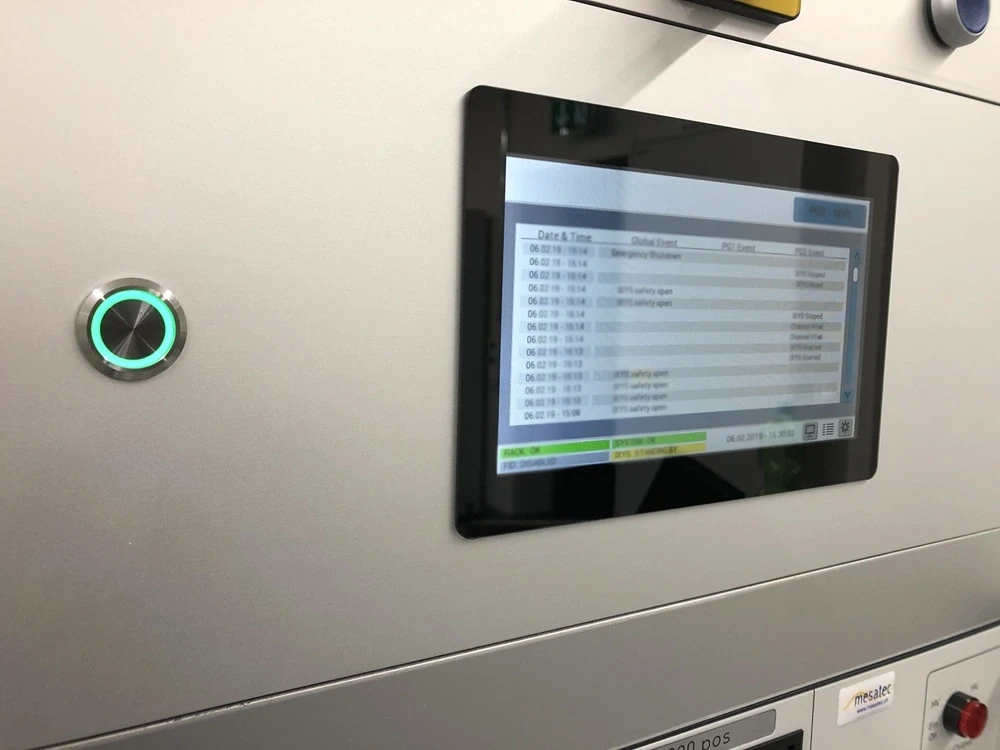
We replace outdated displays and unsupported PC software with modern HMI panels, industrial PCs, or web-based interfaces that can be opened from an office. Beyond the screen itself, this is where usability is won: guided test sequences so results do not depend on who is operating, clear visualisation of results, recipe and parameter management, user management with proper access levels, and alarm handling that says what is wrong rather than showing a code.
The result is a machine that a new operator can learn in an afternoon, and that your own team can maintain for the next ten years.
Hardware and software
Control and software modernization
Control system modernization
Where required, we can also modernize the control layer of the machine. Typical retrofit work includes:
PLC replacement
HMI replacement
Industrial PC replacement
I/O modernization
Drive and motor control upgrades
Sensor integration
Data acquisition hardware
Safety circuit integration
Communication gateway installation
Network integration
The existing machine concept can often remain largely unchanged while outdated components are replaced with supported hardware.
Software modernization
Older test systems often depend on custom software that is difficult to maintain or only runs on obsolete operating systems. We can modernize or replace:
Test sequencing software
Measurement applications
Data acquisition software
Operator interfaces
Result processing
Report generation
Database communication
Device drivers
Communication interfaces
Where possible, we keep the new architecture simple, maintainable, and independent of unnecessary proprietary dependencies.
Results
What a typical retrofit can achieve
A successful retrofit can provide:
Automatic test result collection
Better product traceability
Reduced manual data entry
Faster troubleshooting
Improved machine availability
Easier maintenance
Modern user interfaces
Integration with existing production systems
Remote diagnostics
Standardized data formats
Longer machine service life
Reduced dependence on obsolete hardware and software
How we work
Our retrofit process
Machine assessment
We review the existing machine, control system, instrumentation, software, and available documentation. The objective is to determine what should be retained, what should be replaced, and where the biggest improvement can be achieved.
Retrofit concept
We define the target architecture, interfaces, hardware changes, and software requirements, covering control hardware, communication interfaces, data architecture, HMI or software changes, integration requirements, and the migration strategy.
Engineering and implementation
We develop the required hardware, software, interfaces, and control modifications. Where possible, work is prepared off site to minimize machine downtime.
Installation and commissioning
The new components are installed and tested on the machine. Existing test functions are verified and the new digital features are commissioned.
Documentation and handover
The updated system is documented so that future maintenance and modifications remain manageable.
Extend the value of the equipment you already own
A machine retrofit can be a practical alternative to replacement when the core test system still performs well. By modernizing connectivity, controls, and data handling, existing equipment can become part of a connected and traceable production environment without the cost and disruption of purchasing a completely new machine.
If your test equipment still works but feels disconnected, difficult to maintain, or trapped in outdated technology, a targeted retrofit may be the right solution.