
OT security and industrial connectivity
Our Technology
We came to OT security from inside the machine
Most OT security starts at the network.
Our perspective starts one layer deeper.
Kroemtech has a strong software engineering background across industrial systems, from embedded firmware and PLC logic to backend services, APIs, databases, and operator interfaces.
In practice that means Siemens control systems, STM32 driven IoT devices, industrial protocols, Linux servers, and the web technologies around them.
That gives us a practical understanding of how machines actually behave, what production depends on, and where security controls can be introduced without creating unnecessary operational problems.
Today, that experience is at the core of how we approach OT cybersecurity, industrial connectivity, and system modernization.
Environments
Where we work
We work in environments where a security measure has to earn its place: availability, process safety and regulatory obligations all constrain what is allowed to change. Chemical manufacturing is one of them.
Perspective
How we see a system
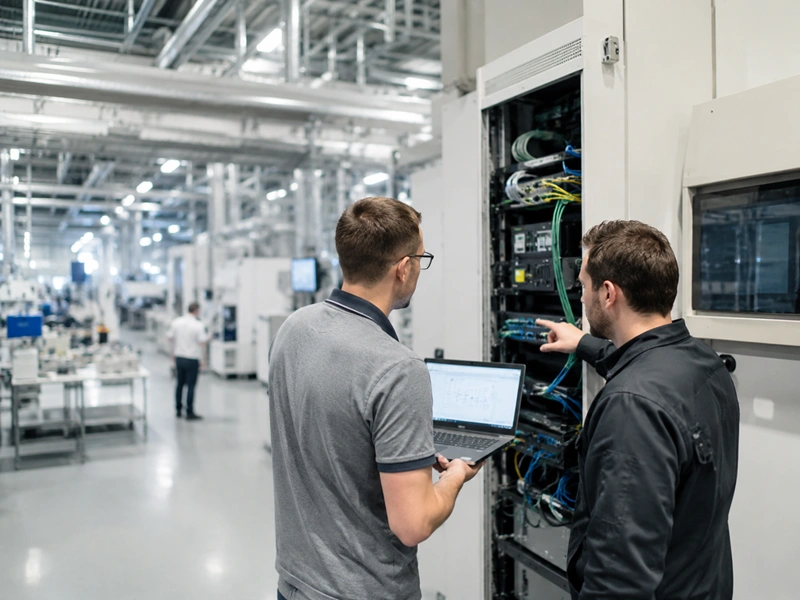
We follow the path from a sensor signal to the controller, from the controller to the network, and from there to the systems where data is stored, analyzed, and presented to the operator.
Because we have worked across these layers, we can look at an OT environment as one complete system rather than a collection of isolated technologies.
Practical questions
Why that matters for OT security
Good OT security is not only about identifying vulnerabilities or closing ports.
The important questions are usually more practical:
Are there safety related functions behind this controller?
Which communications are essential to run the production?
Can the device support modern authentication, or does protection have to be built around it?
Can we trust the data provided by this device?
Answering these questions requires knowledge of control logic, machine software, system dependencies, and production processes.
Security measures that ignore those realities become difficult to operate, difficult to maintain, or are eventually bypassed. Our approach is to design cost effective controls that work in real production environments.
Focus areas
What we focus on
Our work is focused on four areas.
OT Cybersecurity
Assessments, architecture, segmentation, secure remote access, and IEC 62443-aligned security concepts.
Secure Industrial Connectivity
Connecting sensors, machines, devices, and systems while maintaining clear boundaries, secure communication, and manageable architectures.
Backup, Recovery & Continuity
Improving the resilience of control systems so critical operations can be restored quickly when something goes wrong.
Modernization of Test & Production Equipment
Updating legacy control, software, and connectivity layers while preserving the parts of the machine that still provide value.
Approach
How we work
In industrial environments, cybersecurity decisions cannot be separated from production and safety. A control that looks good on paper may be unacceptable if it interrupts a critical process, blocks maintenance, or introduces an operational dependency that did not exist before.
So we work as engineers rather than auditors.
We start by understanding how the system actually operates and what production depends on. We agree what has to remain untouched. We design measures around those constraints, document what changes and why, and hand back an environment your team can maintain without us.
The result is security that is practical, maintainable, and designed for the environment it has to protect.